.png)
Drone Propulsion Systems: Innovations, New Technologies, and Leading Manufacturers

Updated: Jan 12
Drone propulsion systems are undergoing a fundamental transformation. What once revolved around simple electric motors and fixed propellers has evolved into a complex engineering discipline focused on efficiency, endurance, safety, noise reduction, and scalability. As drones move beyond recreational use into logistics, inspection, defense, and future air mobility, propulsion has become one of the most critical performance drivers in unmanned aviation.
Modern drone propulsion systems must support longer flight times, heavier payloads, and increasingly demanding operational environments. At the same time, regulatory pressure, urban operations, and sustainability goals are pushing manufacturers to rethink traditional architectures. This has accelerated the development of advanced electric propulsion, hydrogen fuel cells, hybrid systems, distributed propulsion, and entirely new motor layouts that challenge decades of conventional design.
Innovation in this area is not limited to power sources alone. The way thrust is generated, controlled, and distributed across the airframe is changing rapidly. Emerging concepts such as rim driven propulsion, fan in wing lift systems, and micro turbine powered VTOL platforms are redefining how drones take off, fly, and land.
Table of Contents
Evolution of Drone Propulsion Systems
Drone propulsion started as a direct carryover from hobby aviation: small electric motors, basic propellers, and limited battery capacity. Early multirotors prioritized stability and ease of control over efficiency. They worked, but endurance and payload were modest, and noise plus rotor hazard were accepted as normal tradeoffs. As drones moved into inspection, mapping, public safety, and logistics, propulsion quickly became a system-level engineering challenge rather than a component choice.
Two developments accelerated modern propulsion: higher-performance lithium batteries and widespread adoption of brushless DC motors with electronic speed controllers (ESCs). Brushless systems improved efficiency, control precision, and reliability, allowing drones to scale from small quadcopters into heavy-lift platforms. At the same time, flight controllers began integrating propulsion health signals such as current draw and temperature, enabling better fault detection and safer operation. Propulsion was no longer just “spin the prop.” It became tightly integrated with software, sensing, and airframe design.
As the industry aimed for urban missions, propulsion constraints became more visible. Conventional exposed rotors create safety risks around people and property, especially in tight spaces. Rotor diameter grows with payload, so heavier drones and air taxis often end up with large rotor spans that are difficult to operate safely in cities. Noise is another barrier. Even if electric aircraft are emissions-friendly at the point of use, public acceptance often fails if the acoustic footprint is too high.

Electric Propulsion and High Efficiency Motor Designs
Electric propulsion remains the backbone of most drones because it is mechanically simple, easy to control, and comparatively low maintenance. The major performance lever is efficiency: the fraction of electrical energy that becomes useful thrust rather than heat. High-efficiency designs focus on motor electromagnetic optimization, ESC control strategy, propeller aerodynamics, and thermal management. Improvements here translate directly into longer flight time, better payload capacity, and improved reliability.
Modern high-efficiency brushless motors use refined magnet materials and winding patterns to increase torque density and reduce losses. On the electronics side, ESC improvements focus on smoother commutation, better efficiency under partial load, and higher-quality current control. This matters because drones rarely operate at constant power. They constantly adjust thrust in response to wind, navigation demands, and payload changes. Any inefficiency in the motor-controller system becomes heat, which reduces component life and can force derating in hot environments like the GCC.
Noise reduction is also becoming a prime design driver. Many drones are rejected operationally not because they cannot fly, but because they cannot fly quietly enough for urban and near-population missions. Noise is influenced by propeller tip speed, blade loading, vortex formation, and motor switching characteristics. This is why advanced motor-prop combinations and lower RPM, higher solidity propulsors are gaining interest in emerging architectures like rim-driven systems, which are often discussed as offering potential acoustic and profile advantages.
However, the hard limit for pure battery-electric propulsion is energy density. Even with continuous battery progress, mission profiles like long-range cargo and consistent reserve requirements push designers toward hybrid and hydrogen solutions. In practice, the “future” for electric propulsion is not just better motors. It is better integration: propulsion that is monitored, redundant where needed, designed for maintainability, and compatible with safety constraints in urban environments. This is why you see electric propulsion branching into distributed lift systems, ducted approaches, and alternative motor placement concepts such as rim-driven propulsion, while still remaining the foundation for almost every advanced architecture in development.
Hydrogen Fuel Cell Propulsion for Long Endurance UAVs
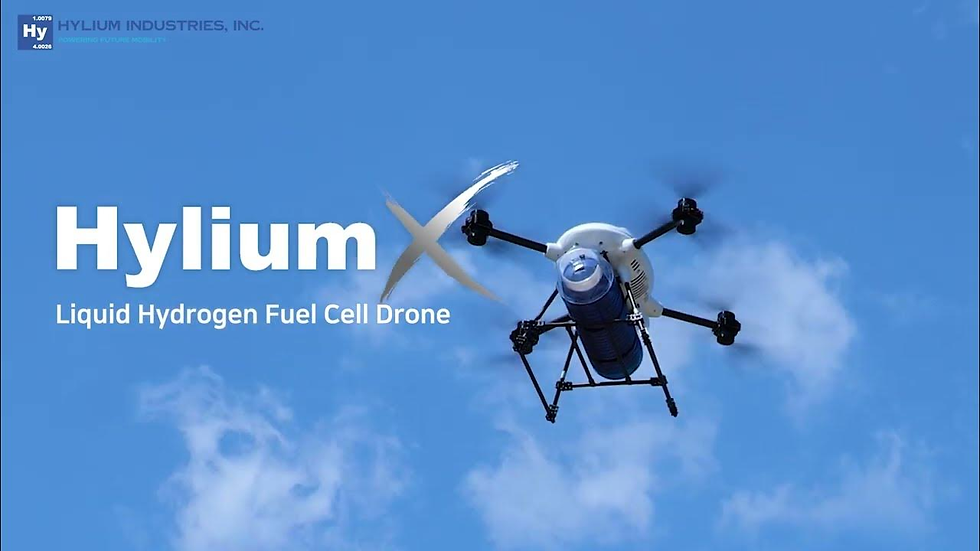
Hydrogen fuel cell propulsion is one of the most practical pathways to multi-hour UAV endurance without switching to conventional combustion. In a typical configuration, a fuel cell stack generates electricity continuously, powering electric motors and charging a small buffer battery that covers transient loads such as takeoff, gust response, and aggressive maneuvers. The aircraft still “feels” electric in control behavior, but endurance improves because hydrogen can store more usable energy per mass than batteries at the system level for certain mission profiles.

Hydrogen propulsion is particularly attractive for fixed-wing UAVs and long-range VTOL cargo drones where time-on-station is critical. It is also relevant where emissions and noise constraints are strict. Fuel cell systems are not silent, but their acoustic signature can be significantly more acceptable than high-power open rotors, especially when paired with efficient propulsors and thoughtful airframe integration.
The operational challenges are real. Hydrogen storage and refueling logistics are the main barriers. Lightweight tanks, safe handling procedures, and field-ready refueling solutions must mature alongside the aircraft. There is also a cost and supply chain question: fuel cell stacks, balance-of-plant components, and hydrogen infrastructure are still scaling. That said, the ecosystem is expanding, and suppliers now position fuel cell solutions specifically for UAV and drone OEM integration, offering product lines, supporting components, and engineering support for integration work.
From a certification and credibility perspective, hydrogen systems benefit from being rooted in established physical principles and a known electrical propulsion chain. The airframe still uses motors and propulsors, and the “new” part is the energy source plus associated systems. That often makes validation pathways clearer than for entirely new thrust generation concepts. For the drone industry, hydrogen is best viewed as a strategic endurance enabler. It will not replace batteries in every segment, but it can unlock missions where battery-only designs are structurally disadvantaged, especially for persistent cargo, inspection corridors, and wide-area monitoring.
Hybrid and Turbine Based VTOL Propulsion Concepts
Hybrid propulsion exists because VTOL missions demand high peak power for takeoff and hover, while cruise demands energy efficiency and reserve margins. A hybrid system typically uses electric propulsion for lift and control, with an onboard combustion engine, generator, or microturbine providing sustained energy for cruise and battery recharge. This gives a practical range improvement while retaining electric-style control authority.
Microturbine based VTOL concepts sit at the high-power end of the spectrum. They can deliver significant power in compact form factors and refuel quickly, which is attractive for emergency logistics and time-critical supply operations. Some VTOL platforms use multiple microturbine thrusters to generate lift directly. The value proposition is speed, rapid redeployability, and potential endurance advantages over battery-only systems, with the tradeoff being mechanical complexity, heat management, and operational cost.
Hybrid systems also appear prominently in advanced air mobility and heavy UAV concepts. A common approach is electric lift for vertical phases plus an engine-assisted cruise. This can reduce the battery mass required to meet mission range and reserve requirements. It also addresses practical issues like de-icing, cabin heating, and maintaining energy margins, which become important as aircraft scale toward passenger or high-value cargo missions. A recent example in the broader hybrid eVTOL space is Horizon Aircraft’s direction with a hybrid-electric aircraft concept and selection of a conventional turbine engine for its platform strategy.
For the drone market, hybrid propulsion is a strong candidate for middle-ground missions: longer-range VTOL cargo, maritime logistics, and operations where batteries alone either make the vehicle too large or reduce payload too much. In urban environments, hybrid designs must still solve noise and safety, so they are often paired with ducted or distributed lift architectures rather than large open rotors. Hybrid is not a single technology. It is a design philosophy that trades power source complexity for operational capability.
Distributed and Fan Based Lift Architectures
Distributed propulsion replaces one or two large propulsors with many smaller ones distributed across the airframe. This architecture improves redundancy, control authority, and sometimes acoustic behavior. If one unit degrades, the aircraft can often maintain controlled flight. Distributed propulsion also enables new configurations, including wing-integrated lift systems that transition from vertical lift to efficient wing-borne cruise.
Fan based lift architectures, including ducted fans and fan-in-wing systems, are often adopted to reduce hazard from exposed blades and to improve integration into compact airframes. Ducting can also shape airflow and potentially reduce tip vortex noise, depending on design choices, RPM, and blade loading. The main tradeoff is that ducts add weight and can reduce peak efficiency if not carefully engineered. Still, for urban operations, safety and footprint can outweigh pure efficiency comparisons.

Fan-in-wing approaches embed lift fans into wing structures to keep the aircraft compact and to support a controlled transition to forward flight. The intent is to deliver VTOL capability without relying on large exposed rotor diameters. This is directly connected to the urban problem statement: cities constrain width, landing zones, and proximity to people. Architectures that reduce span and protect rotating elements can remove major operational barriers. Horizon Aircraft publicly emphasizes a fan-based lift strategy in its concept, and independent coverage describes its fan-in-wing approach for VTOL and transition flight.
In the drone segment, distributed lift is already proven in multirotors, but the “future” angle is in scaling and integration: quieter distributed systems, enclosed fans, and designs that can carry meaningful cargo while remaining human-compatible in tight environments. This is exactly where propulsion architecture becomes a business enabler. If you cannot operate safely and quietly near people, the mission fails regardless of aerodynamic efficiency. Distributed and fan based lift architectures are therefore a major pillar of future cargo drones and air taxis, especially when paired with hybrid or hydrogen energy sources.
RimThrust and the Future of Rim Driven Propulsion
Rim driven propulsion relocates the motor’s electromagnetic drive components from the hub to the outer rim of a ducted propulsor. Conceptually, it removes the central shaft and hub motor volume, which can allow new blade geometries and potentially enable compact, enclosed thrust modules with fewer exposed moving parts. In discussions of rim driven electric aircraft propulsion, one recurring claim is the possibility of operating at lower RPM with higher solidity blades, reducing acoustic signature while preserving thrust.
RimThrust positions itself specifically around next-generation rim driven propulsion for UAV and VTOL applications, emphasizing safety, scalability, and a rethinking of how electric thrust can be packaged for future aircraft designs. RimThrust From an engineering perspective, rim driven architectures are attractive for three reasons.
First, integration. A rim-driven unit can be designed as a self-contained thrust module, potentially easing installation, maintenance access planning, and structural integration into ducts, wings, or lift pods. Second, safety. Enclosed propulsion aligns with the urban requirement to minimize exposed hazards. Third, scalability. As UAV and VTOL platforms grow, the propulsion system often becomes a dominant driver of vehicle footprint and noise. Rim-driven concepts attempt to address these constraints by changing the physical arrangement of the drive system rather than only refining the motor.
That said, rim-driven propulsion is not a guaranteed advantage in every use case. It must prove thermal robustness, foreign object tolerance, manufacturing viability, and certification readiness in aviation conditions. Many rim-driven products exist in other industries, but UAV and eVTOL adoption requires meeting aviation safety expectations and rigorous validation.
For AVA AERO’s audience, the value in covering RimThrust is that it represents a credible direction of travel: a move toward safer, enclosed, modular electric propulsion that is compatible with the practical realities of urban aerial operations. It fits naturally into the same narrative as ducted fans and distributed lift, while also being distinctive in architecture and packaging.
Propulsion system category | Example technology or company | Website |
Battery electric propulsion with high efficiency motors | BETA Technologies | |
Battery electric propulsion with high efficiency motors | Joby Aviation | |
Battery electric propulsion with high efficiency motors | Archer Aviation | |
Hydrogen fuel cell electric propulsion | H3 Dynamics | |
Hydrogen fuel cell electric propulsion | Doosan Mobility Innovation | |
Hybrid electric VTOL propulsion | Horizon Aircraft | |
Microturbine and jet based VTOL propulsion | FusionFlight JetQuad | |
Distributed and fan based lift architectures | Lilium | |
Distributed and fan based lift architectures | Horizon Aircraft | |
Rim driven electric propulsion | RimThrust | |
Looped track reaction engine propulsion | Bahmani propulsion system | |
Looped track reaction engine propulsion | European patent reference |
Patent and Evidence: Real-World Validation of Bahmani’s Propulsion System
One of the most credible developments in novel UAV propulsion in recent years is the propulsion system patented under European Patent EP3565971B8. This patent, granted by the European Patent Office (EPO), defines a method and system for generating efficient thrust by accelerating reaction engines along a looped track and using centrifugal interaction to transfer force to the vehicle structure. According to public patent databases, the invention was filed in November 2017 and published in its granted form in January 2023, with an active legal status, giving priority back to a 2016 priority date for novelty evaluation.
The patent is classified in propulsion-related categories under the European classification F03H99/00, reflecting its intended application in novel thrust generation mechanisms not covered by traditional propeller or turbine groupings. You can review the full bibliographic details and legal status directly on the European patent portal:
• Google Patents entry with priority and classification data: https://patents.google.com/patent/EP3565971B8/en
• PubChem’s patent aggregation: https://pubchem.ncbi.nlm.nih.gov/patent/EP-3565971-B8
These records confirm that the invention meets the core patentability criteria of novelty, inventive step, and industrial applicability as required by the EPO. Particularly for aviation and urban mobility, this credential is significant because the patent office’s examination process involves rigorous assessment by technically qualified examiners before a grant is issued.
Beyond the written documentation, visual demonstrations provide further technical context. Two informative videos illustrate the core concept and experimental realizations of the system:
• Introduction and conceptual overview:
Operational principles and prototype demonstration:
Key Manufacturers and the Road Ahead for UAV Propulsion
The future of UAV propulsion will be shaped less by a single winner and more by mission segmentation. Short-range inspection and consumer drones will stay battery-electric with incremental improvements. Long endurance and persistent missions will increasingly adopt hydrogen fuel cells. Heavy VTOL cargo will likely converge around hybrid architectures. Urban air mobility will push hard toward quieter, safer, enclosed propulsion and compact footprints.
Beyond patents, market credibility also comes from integration partnerships, scalable manufacturing, and certification progress. That is why “top players” often include both propulsion technology firms and airframe OEMs who can demonstrate flight testing, transition flight, and production planning. In the broader eVTOL ecosystem, companies such as Joby, Archer, and Lilium represent high-visibility electric propulsion development programs, while BETA demonstrates a clear propulsion configuration disclosure for its aircraft.


Comments