.png)
Aging Aircraft Fleets: Demand for Advanced MRO Equipment

Introduction
Aircraft delivery delays, record manufacturer backlogs and growing passenger demand are forcing airlines to keep existing aircraft in service longer. The average global fleet age has increased, while operators are flying many aircraft for more hours and cycles than previously anticipated. This does not mean older aircraft are inherently unsafe, but it does increase the need for structural inspections, corrosion control, component overhaul, pressure testing and accurately documented maintenance.

As aging aircraft require more frequent and technically demanding maintenance, airlines and MRO organizations are investing in advanced MRO equipment that improves testing accuracy, inspection capability, operational safety and regulatory traceability. This includes hydraulic test stands, component test benches, nondestructive testing systems, nitrogen and oxygen servicing equipment, aircraft jacks, maintenance platforms and automated data-acquisition systems.
For the Middle East, the opportunity is especially significant as airlines expand in-house maintenance capabilities and regional MRO providers invest in new hangars, component shops and engine facilities. AVA AERO supports these requirements by supplying specialized aircraft maintenance, hydraulic testing and ground support equipment.
Why the Global Aircraft Fleet Is Aging
The global commercial aircraft fleet is aging primarily because aircraft manufacturers and their suppliers have not been able to deliver new aircraft at the rate required by airlines. Strong passenger demand has returned, but production constraints involving engines, raw materials, electronic components, skilled labour and quality-control processes continue to delay fleet renewal.
According to IATA, aircraft delivery shortfalls have exceeded 5,300 units, while the global order backlog has surpassed 17,000 aircraft. This backlog is equivalent to almost 12 years of production at current manufacturing rates. As airlines cannot obtain enough new aircraft, they are retaining existing aircraft, returning some stored aircraft to service and increasing the utilization of available fleets.
IATA estimates that the average age of the overall aircraft fleet has reached 15.1 years. Passenger aircraft average approximately 12.8 years, wide-body aircraft 14.5 years and cargo aircraft 19.6 years. Oliver Wyman uses a narrower commercial in-service fleet definition and reports an average age of nearly 13 years in 2025. Although the figures differ because of their respective methodologies, both sources confirm the same direction: aircraft are remaining in operation longer.

Chronological age alone does not determine an aircraft’s condition. Flight cycles, flight hours, operating environment, maintenance history, previous structural repairs and compliance with approved maintenance programmes are often more significant. An aircraft that has been properly inspected and maintained can remain safely operational for decades.
However, longer service lives create additional maintenance requirements. Older aircraft generally require more structural inspections, corrosion monitoring, component overhauls, replacement parts and functional testing. Consequently, demand is increasing for advanced MRO equipment capable of accurately evaluating aircraft structures, hydraulic components, landing gear, pneumatic systems, engines and other safety-critical assemblies.
This situation is expected to continue. Oliver Wyman forecasts that aircraft production constraints will remain influential until at least 2030, potentially preventing the manufacture of more than 6,000 aircraft that might otherwise have entered service. Airlines and MRO providers must therefore prepare to support both aging legacy platforms and newer aircraft experiencing unexpected engine and component durability problems.
How Aircraft Aging Changes Maintenance Requirements
Aircraft aging affects structures, mechanical components, hydraulic systems, electrical installations, seals and interior systems in different ways. Maintenance programmes must account for the combined effects of fatigue, corrosion, wear, erosion, contamination and environmental exposure.
Repeated pressurization cycles and aerodynamic loads can gradually produce fatigue damage in fuselage skins, frames, pressure bulkheads, wing attachments, door surrounds and previously repaired areas. EASA’s aging-aircraft requirements address structural risks including basic-design fatigue, widespread fatigue damage, corrosion and fatigue associated with repairs or modifications. Operators may need to introduce additional inspections or structural modifications as aircraft approach specified flight-cycle or flight-hour limits.

Corrosion is another important concern. Moisture, condensation, cleaning chemicals, salt exposure and accumulated contaminants can affect wheel wells, battery compartments, lower fuselage areas, galleys, lavatories and drainage zones. Aircraft operating in coastal or humid environments require carefully managed corrosion-prevention and control programmes.
Mechanical and hydraulic components experience wear through repeated movement, pressure cycles, heat and contamination. Pumps, motors, valves, actuators, accumulators and landing-gear components may require more frequent removal, inspection and functional testing. Aging seals, O-rings and flexible hoses can also increase the probability of leakage or pressure loss.
These conditions increase the workload of both line and base maintenance. Line-maintenance teams need dependable diagnostic and servicing equipment to identify faults quickly and return aircraft to service. Heavy-maintenance and component shops need test benches capable of reproducing operating pressure, flow, temperature and mechanical loads under controlled conditions.
Maintenance traceability becomes equally important. Test results must be repeatable, recorded and associated with the correct component, maintenance procedure and calibration status. Modern test systems can automate test sequences, collect measurement data and produce standardized reports, reducing the risk of inconsistent manual documentation.
The financial impact is already significant. IATA estimates that maintaining older aircraft added approximately $3.1 billion to airline costs in 2025. Airlines also spent more on spare engines, replacement components and inventory because of extended repair turnaround times. Advanced MRO equipment can help reduce these pressures by improving fault identification, supporting safe in-house repairs and reducing unnecessary component shipments to overseas repair facilities.
Advanced Inspection and Testing Technologies
Traditional maintenance equipment remains essential, but aging fleets require greater measurement accuracy, inspection sensitivity and data traceability. Modern inspection and test systems help technicians detect deterioration before it develops into a major operational or safety problem.
Nondestructive testing, commonly called NDT, allows technicians to inspect aircraft structures and components without damaging them. Eddy-current equipment is frequently used for detecting surface and near-surface cracking in conductive materials. Ultrasonic and phased-array systems can identify internal discontinuities, corrosion-related material loss and defects that may not be visible during a conventional inspection. Digital borescopes provide access to engines, ducts, internal structures and other areas that would otherwise require extensive disassembly.
Advanced component test benches reproduce the operating conditions experienced by pumps, motors, valves and actuators. Sensors measure pressure, flow, temperature, rotational speed, torque and leakage. Programmable test sequences can guide technicians through approved procedures and automatically compare results with established acceptance limits.
Technology | Primary application | Principal advantage | Typical limitation |
Visual inspection | General condition and accessible damage | Fast and economical | Limited to visible areas |
Eddy-current testing | Surface and near-surface cracks | Highly sensitive to small defects | Requires trained interpretation |
Ultrasonic testing | Internal defects and material thickness | Detects hidden damage | Surface preparation may be required |
Digital borescope | Engines, ducts and confined areas | Reduces disassembly requirements | Access depends on inspection openings |
Automated test bench | Hydraulic and mechanical components | Repeatable testing and digital reporting | Requires correct adapters and procedures |
Vibration analysis | Engines, pumps and rotating equipment | Identifies imbalance and bearing deterioration | Results depend on operating conditions |
Digital data acquisition is increasingly important. Instead of relying solely on manually recorded gauge readings, connected systems can capture measurements continuously, identify deviations and generate complete test reports. Calibration information, operator identification, component serial numbers and test dates can also be stored with the results.
This does not eliminate the need for qualified technicians. Inspection findings and test data must still be evaluated against approved aircraft maintenance manuals, component maintenance manuals and regulatory requirements. The purpose of advanced MRO equipment is to improve consistency, visibility and efficiency while supporting, rather than replacing, professional engineering judgment.
Essential MRO Equipment for Aging Aircraft Fleets
Supporting an aging fleet requires a combination of inspection systems, component test equipment, aircraft servicing units and safe handling solutions. The appropriate equipment package depends on aircraft type, maintenance scope and whether the facility performs line maintenance, base maintenance or component overhaul.
Hydraulic test stands are among the most important systems for component and aircraft maintenance. They provide controlled hydraulic pressure and flow for testing pumps, motors, valves, actuators and complete aircraft hydraulic circuits. Modern units can incorporate variable pressure, temperature control, fine filtration, contamination monitoring and automatic data recording. Dedicated flushing and filtration units are also required to remove contamination after component failure or maintenance intervention.
Aircraft nitrogen and oxygen equipment remains essential throughout the fleet’s service life. Nitrogen is used for tires, landing-gear struts, accumulators and system servicing. Oxygen carts support crew and passenger oxygen systems. Service equipment may include cylinder carts, boosters, regulators, charging hoses, aircraft adapters and self-generating nitrogen systems. Self-generating units can reduce cylinder handling and improve the availability of high-pressure nitrogen at larger MRO facilities.
Landing-gear and wheel maintenance requires correctly rated axle jacks, tripod jacks, wheel dollies, brake-change trolleys and strut-servicing equipment. Maintenance platforms and docking systems provide safe access to engines, wings, stabilizers, fuselage areas and elevated inspection points. Equipment dimensions and working loads must correspond to the supported aircraft models.

Cabin leakage testers are used to evaluate pressurization integrity and help locate air leakage through doors, seals, fuselage areas and system connections. Pneumatic test equipment can support valves, air-cycle machines and environmental-control components. Ground power units, battery analyzers and electrical test sets allow maintenance teams to troubleshoot aircraft systems without operating the engines or auxiliary power unit.
For engine and structural work, facilities may require digital borescopes, NDT systems, vibration analyzers, engine stands and specialized lifting fixtures. Each system must be supported by appropriate calibration, training, approved procedures and documented maintenance.
The strongest investment strategy is therefore not simply purchasing individual machines. Airlines and MROs should develop integrated equipment packages that combine testing, adapters, tooling, data recording, calibration and after-sales support around their actual aircraft fleet and approved maintenance capabilities.
Middle East Fleet Growth and MRO Investment
The Middle East combines rapid fleet expansion with increasing investment in local maintenance capability. Oliver Wyman forecasts that the region’s commercial fleet will grow from approximately 1,685 aircraft in 2026 to 2,808 aircraft by 2036. This represents average annual growth of about 5.2%, making the Middle East one of the world’s fastest-growing aviation regions.
Wide-body aircraft are especially important. Their number is projected to increase from 842 to 1,436 during the same period. These aircraft require high-capacity jacking, access, hydraulic servicing, ground power, cabin testing and component-maintenance equipment. The region’s position as a long-haul hub also means aircraft accumulate substantial flight hours, creating continuous demand for line maintenance, component testing and scheduled overhaul.
Regional MRO demand is expected to grow from approximately $18.6 billion in 2026 to $27.7 billion by 2036. Engine maintenance represents the largest segment, accounting for approximately $12.1 billion in 2026. Component and line-maintenance demand are also expected to grow considerably as airlines add aircraft and develop more internal repair capabilities.
Major investments confirm this direction. Emirates is expanding its engineering and engine-repair capabilities while constructing a new engineering complex at Dubai South. Its average fleet age reached 10.8 years in 2026, compared with approximately five years in 2016. Delivery delays have contributed to the continued operation and extensive refurbishment of its Airbus A380 and Boeing 777 fleets.
In Abu Dhabi, Sanad is expanding its engine MRO capabilities for programmes including the Trent 700, V2500, LEAP, GEnx and Pratt & Whitney GTF. Saudi Arabia is also investing in additional hangars and component shops through the Saudia Technic MRO Village.
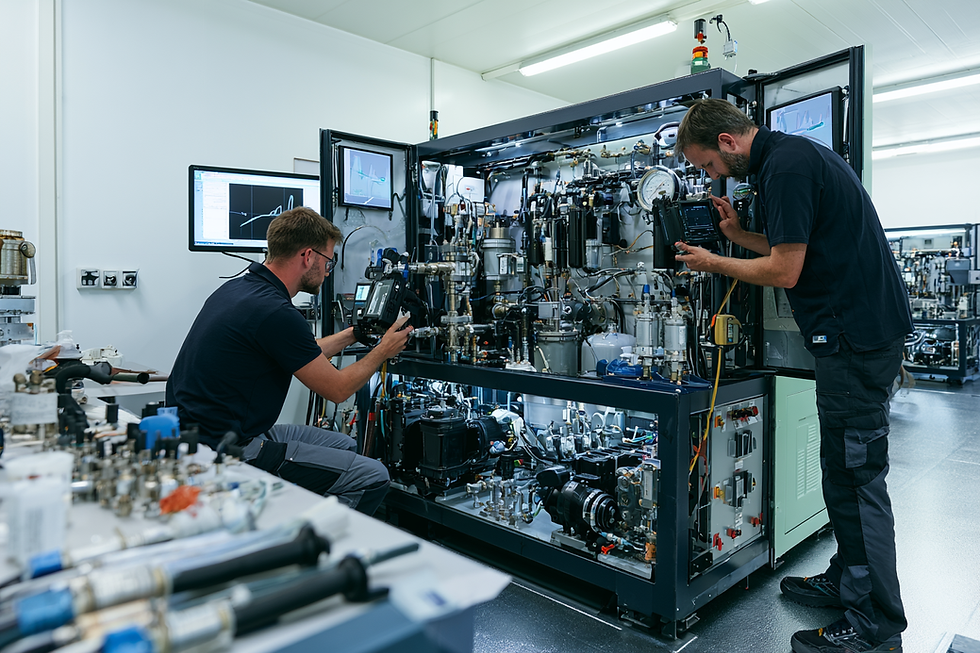
These developments create demand beyond complete engine-overhaul facilities. New and expanded MRO organizations require hydraulic test stands, component benches, aircraft jacks, maintenance platforms, nitrogen and oxygen systems, cabin leakage testers, ground power equipment and calibrated workshop tools. Suppliers that can combine equipment selection, aircraft compatibility, commissioning, training and regional support will be better positioned to participate in this expansion.
Selecting and Maintaining Advanced MRO Equipment
Selecting advanced MRO equipment begins with defining the facility’s approved maintenance scope. An airline performing line maintenance has different requirements from a component shop overhauling hydraulic pumps, motors, actuators or landing-gear assemblies. Procurement decisions should therefore be based on actual aircraft types, component part numbers, maintenance manuals, anticipated workload and future capability-development plans.
Aircraft and component compatibility must be verified before purchase. Hydraulic test equipment should provide the required pressure, flow, temperature, filtration and fluid compatibility. Jacks and lifting equipment must have the correct capacity, closed height, lifting range and aircraft interface. Nitrogen and oxygen equipment must include compatible regulators, hoses, charging adapters, cleanliness requirements and pressure ratings.
Buyers should evaluate the complete life-cycle cost rather than only the initial equipment price. Important considerations include:
Installation and commissioning requirements
Calibration frequency and local calibration availability
Preventive maintenance requirements
Spare-parts availability
Equipment lead time
Operator and maintenance training
Software licensing and updates
Availability of aircraft-specific adapters
Technical support and warranty conditions
Expected service life and future upgrade options
Equipment flexibility is valuable when a facility supports multiple aircraft platforms. A configurable hydraulic test bench may accommodate several component types, provided that the correct adapters, procedures and acceptance limits are available. Modular designs can reduce the need to purchase separate machines for every application, but excessive customization can increase technical complexity and calibration requirements.
Digital features should also be assessed carefully. Automatic test sequences, data acquisition and report generation can improve consistency and traceability. However, the system must allow technicians to use approved test procedures and maintain control over acceptance criteria. Proprietary software that cannot be updated, exported or supported locally may become a long-term operational risk.
Once installed, advanced MRO equipment must itself be maintained. Pressure gauges, flow meters, temperature sensors, torque transducers and safety devices require scheduled inspection and calibration. Hoses, filters, seals and hydraulic fluids must be monitored and replaced as necessary. Complete equipment records should include calibration certificates, maintenance history, software versions, reported faults and corrective actions.
A structured procurement and maintenance strategy ensures that equipment remains accurate, safe and available throughout its intended service life.
Future MRO Demand, Digitalization and Conclusion
Demand for advanced MRO equipment is expected to remain strong throughout the next decade. Aircraft-production constraints are unlikely to disappear immediately, and airlines will continue operating established fleets while gradually introducing new-generation aircraft. MRO facilities must therefore support legacy platforms and newer aircraft simultaneously.
The resulting maintenance environment will be increasingly complex. Older aircraft require fatigue inspections, corrosion management, component overhaul and life-extension work. Newer aircraft bring composite structures, integrated avionics, digitally controlled systems and new engine technologies that require different inspection methods and technical skills. Equipment manufacturers will need to design systems that are adaptable, digitally connected and capable of supporting several aircraft generations.
Automation will play a larger role in component testing. Modern test benches can automatically control pressure, flow, temperature and mechanical loads while recording results throughout the test. Predictive analytics may help maintenance organizations identify developing equipment problems and schedule intervention before a failure interrupts production. Digital calibration and maintenance records will further improve audit readiness and technical traceability.
Portable NDT systems, high-resolution borescopes and advanced imaging technologies will make aircraft inspections more efficient. Robotic and drone-assisted inspection may reduce the time required to examine large external surfaces, although regulatory approval, technician oversight and accurate defect validation will remain essential.
Sustainability will also influence equipment procurement. Energy-efficient test benches, electric ground support equipment, reusable filtration systems and self-generating nitrogen units can reduce waste, fuel consumption and dependence on delivered gas cylinders. The environmental benefit should be measured through energy use, maintenance requirements and total equipment life rather than marketing claims alone.
The continued safe operation of aging aircraft ultimately depends on approved maintenance programmes, qualified personnel and reliable equipment. Aircraft age by itself is not the principal risk. The greater concern is whether operators have sufficient inspection, testing and repair capability to identify deterioration and complete required maintenance accurately.
As global fleets age and Middle Eastern MRO capacity expands, investment in advanced MRO equipment will become a strategic requirement. The most successful facilities will combine capable personnel with accurate test systems, safe handling equipment, digital traceability and dependable technical support.

AVA AERO Support for Airlines and MRO Facilities
AVA AERO supplies specialized aircraft ground support, hydraulic testing and maintenance equipment to airlines, MRO organizations, airports and government operators across the Middle East.
Our available solutions include hydraulic test stands, component testing equipment, nitrogen and oxygen servicing systems, aircraft jacks, maintenance platforms, wheel and brake handling equipment, cabin leakage testers, ground power equipment and aircraft-specific maintenance solutions.
AVA AERO can assist customers in reviewing their aircraft fleet, maintenance scope and technical requirements to identify suitable equipment configurations, adapters and supporting accessories.
To discuss an aircraft maintenance equipment requirement or request a technical quotation, contact the AVA AERO team through www.avaet.com.
aging aircraft maintenance, aircraft MRO equipment, aircraft maintenance equipment, aircraft life extension, aviation component test equipment, aircraft hydraulic test stand, aging aircraft inspection, aviation MRO market 2026, airline in-house MRO, aircraft component repair equipment, MRO equipment supplier Middle East, aircraft maintenance equipment UAE, aircraft testing equipment, aviation maintenance technology


Comments